Showing posts with label rare earth. Show all posts

Dec 27, 2012

ibliss (rare earth XXIX)

 ibliss - supernova (spiegelei-aamok, 1972)

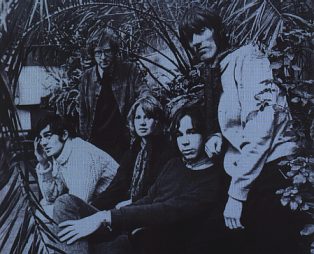
Borne out of the confused Kraftwerk history, and taken under the wing of Conny Plank, Ibliss were one of the most remarkable one album wonders. Featuring Basil Hammoudi (from Organisation) and Andreas Hohmann (one of the two drummers on the first Kraftwerk album) augmenting a trio of no less talent, Ibliss created a logical jazz-fusion diversion on the Organisation sound, heavily featuring flutes, saxes and an overdose of percussion. All this in a typically Teutonic cosmic concoction, kinda Kraftwerk meets Miles Davis and Rocksession era Embryo, and also hinting at the later Kollektiv. It's a great shame they only released the one album!  the crack in the cosmic egg

Al rastrear en los primeros y geniales Kraftwerk y, en sus electrificantes y experimentales sesiones es recurrente recuperar el mágico 'Tone Float' de Organisation. Entre aquellos restos (Andreas Hohmann, Basil Hammoudi) también quedó uno de los tesoros mejor escondidos del krautrock, que dejaría sorprendido al explorador de ideas preconcebidas, pues si hubiéramos de situar su contenido serían Annexus Quam, Ikarus, Niagara o Embryo símiles de excepción. Percusiones repetitivas y tribales con exploraciones de saxo y guitarra en la infecciosa 'Margah', el trance ya ha comenzado. Sigue el interludio cósmico de 'Drops', puro y sinuoso jazz cósmico sobre el que levitar de la mano del saxo de Rainer Buechel. 'High life' continúa por esa senda evocadora, dominada por una eterna línea de bajo e improvisaciones flautiles. La mántrica 'Athir' supone el despertar, veo la India a lo lejos cuando el chamán nos invoca de vuelta a la quietud de la noche y a sus extraños moradores.
 

Dec 6, 2012

erkki kurenniemi (rare earth XXVIII)


One of the undeniable pioneers of Finnish electronic music is Erkki Kurenniemi (b. 1941), who founded The University of Helsinki Electronic Music Studio in the early 1960's. Kurenniemi built his own series of synthesizers, named as DIMI, which are nowadays mostly possessed by Swedish collector and electronic musician Ralph Lundsten, and published some of his experimental compositions like 'Dance of the Antropoids'. Alongside such Finnish pioneers as Eino Ruutsalo (for whose short films Kurenniemi composed music), Kurenniemi also did some early work on the field of Finnish media art and contributed to Finnish video art and happenings. These days Kurenniemi works as an independent researcher, specialising in such subjects as artificial intelligence. finnscene

A former nuclear scientist who composed computer-based music and designed his own instruments founding the University Of Helsinki Electronic Music Studio in 1962.  Kurenniemi's pioneering work included microprocessor-based digital synthesizers built in the early 1970's. discogs

Siempre he sentido una especial atracción hacia los primeros aventureros de la música electrónica, más allá incluso de sus propias grabaciones, sólo el hecho antropológico de indagar en sus técnicas, instrumentos y creaciones ya me fascina. Desde visionarios creadores y académicos como Stockhausen, Moondog, Morton Subtonick o el propio Erkki a inefables exploradores del underground como Brucke Haack o Silver Apples, estos nombres son fiel reflejo de la libertad creativa del momento y de su desarrollo al margen de la industria y sus tendencias. Esta recopilación de grabaciones del finlandés nos tranpsortará a un solitario collage sónico lleno de sugerentes improvisaciones y cintas maniupaladas en 'hana', 'antropoidien tanssi' o ' mix master universe 2' y hasta alguna melodía presa de inteferencias en 'invention'. 

Para los curiosos, en el siguiente paper encontraréis una revisión de los sintes y secuenciadores que Erkki construyó durante este período y que llegó a utilizar en sus grabaciones o directos, tales como su mítico Dimi.

Sep 8, 2012

peter howell & john ferdinando (rare earth XXVII)

peter howell and john ferdinando - alice through the looking glass (uk, 1969)

Alice... is a charming, ornate slice of English whimsy with an appeal that surely extends beyond the limited audience at which it was aimed back in 1969. Much of the attraction obviously delves from Lewis Carroll's surreal poetry, but some of the musical templates are genuinely inspired, end the project is clearly coloured by the more melodic English psychedelic acts of the late 1960s such as the Moody blues and the Pink Floyd (indeed, Alice has been compared else were to a more pastoral equivalent of "Piper At The Gates of Dawn"). There are numerous highlights scattered throughout the album, but pride of place must go to Jabberwocky, an impressive melange of treated vocals and backward tapes that is worth the price of admission alone. With its drowsy atmosphere, myriad sound effects and languid organ-based sound, Alice certainly invokes the spirit of the psychedelic age, albeit from the perspective or photogenic Middle England rather than hallucinogenic Middle Earth. Rarely can an album or book have ended with a more apposite line. Life - what is it but a dream?". David Wells - psychedelic folk

Han sido muchas las veces en que he pensado hablar Ithaca o Agincourt pero que mejor que empezar la historia de peter y john desde el princpio. No creo que muchos nombres representen mejor el espíritu de estos rare earth que el dúo surgido de la pequeña villa de Ditchlinf en Sussex. Hasta la reedición y recuperación de las cintas orginales a mediados de los ochenta con 'A game for All Who Know', sus grabaciones no fueron más allá de, en el mejor de los casos, prensajes privados de 100-200 copias, quedándose su debut en unas 70. Más tarde fueron llegando las reediciones de acme, background o lion.  

Psych-folk desde la inglaterra medieval en clave naif y con el aroma inconfudible a home recording, la magia imperfecta que el dúo imprimió a todas sus grabaciones se combina con la poesía surrealista de Lewis Caroll. Además se intercalan fragmentos hablados que rompen la estructura de canciones, dejándome sensanciones al estilo de Mayo Thompson. Así es difícil describir que se siente con 'the march of the chessmen', 'dam and dee' o 'jabberwocky', quizá sea eso, un sueño. Para los curiosos el sinfín de instrumentos que desfilan en 'alice through the looking glass'  son: órganos, chirimías, mandolinas, glockenspiel, guitarras, bajos, pianos, auto-arpas, varios instrumentos de percusión extraños y un número de técnicas peculiares de grabación.

Oct 23, 2011

john terlazzo (rare earth XXVI)


"Dark loner poet folk/rock. Very heavy Leonard Cohen influence, but makes LC seem cheerful by comparison. Even the one song that is upbeat, almost good-timey, has a dark undertone. Terlazzo is accompanied on many tracks by a beautiful haunting female backing vocal which is often wordless. Several tracks have fine electric guitar leads and solos. The poetic nature of his writing rather stark and often “esoteric” lyric images, brought out well by his rather limited baritone voice. I rate this at the top of the loner folkie heap." Patrick Lundborg /Acid Archives.

No sé que más añadir, sólo la poesía de 'Avalanche' de Leonard Cohen o 'Things Behind The Sun' de Nick Drake se acerca a 'Honour Among Thieves' o 'The Older Code'.

Jan 4, 2010

mustafa ozkent (rare earth XXV)


In those days, outside the core of Western musical culture, an instrumental album with somehow psychedelic improvisations was never called "psychedelic", more labelled as A Go-Go, often dance rhythm related item. Acid jazzrock was more often one influence for such music. Similar try-outs were already done by groups like Gence 5, who later further developed the jazz reference (evolving to Gence 10). Psychfolk.

The best in early '70's Turkish pop is presented here, an extremely rare unbelieveably forward thinking record that has to be heard to be believed. Drums riffs, healthy solos and high end brass attacks fill this album. Not featuring any vocals or 45 releases, it achieved high club value and was constantly played on the TV and radio on its Turkish release in 1973, but like many Turkish LP's of the time most copies were destroyed or recycled. Perfect for all instrumental psychedelia collectors, this is a genuine find. Great cover as well. freak emporium

Pendiente desde
Ananda Shankar, quizá el mejor y más raro album del psych-rock del middle east que mira hacia occidente. Mustafa Özkent habitual músico de estudio grabó con su banda Orkestasi alguna gema perdida a principios de los setenta. Repleto de efectos, improvisaciones, anatolian-folk, 'Gençlik Elele' es funk-jazz turco a-go-go. La hipnosis rítmica definitiva.

Jun 21, 2009

ananda shankar (rare earth XXIV)


For lovers of psychedelic sitars, here is the classic 1970 release by Ananda Shankar (Ravi's nephew). A full rock band backs Ananda, a hip and genuine master of the sitar. Great raga instrumentals, as well as versions of "Jumping Jack Flash" and "Light My Fire" are laced with trippy moogs, effects etc. Easily the best album of it's kind.Sitars and psychedelia,a 1970 cult classic.

Regresan los rare earth tras demasiado tiempo ausentes y con muchos discos en borradores, para continuar en la India. El sobrino de Ravi Shankar grabó durante finales de los 60 y principios de los 70 un puñado de discos tan oscuros como notables, poniendo sus miras en los grandes nombres del momento pero al cobijo de la influencia musical con la que había crecido. El mejor ejemplo quizá sea este homónimo álbum, infecciosos y mágicos ragas de etnic-psychedelic, de los que emanan libres sitares, moogs y más y más efectos. No hay palabras para la versión de "Jumping Jack Flash" convertido en un himno del raga-rock. Sirva además este rare earth como antesala a un preferido, el turco Mustafa Özkent y su inencontrable Genclikle Elele, quien también circula por las latitudes del eastern-rock que mira hacia occidente.

Oct 10, 2008

clem alford (rare earth XXIII)


Clem Alford was born in Glasgow, Scotland, where he studied the Scottish national instrument, the bagpipes. He was introduced to the sound of the sitar in the mid sixties. He travelled to India and studied under Pandit Sachindranath Saha, principal of the Midnapore Music College in West Bengal. He secured the diploma of Sangeet Sudhakar for expertise in sitar from Surer Maya Sangit Samaj of Calcutta in 1970. Clem's first major recital was in Bombay in november 1970, an event which the Times of India flashed in its headlines as "American's astounding skill, ease in sitar" (a slight case of mistaken nationality!). It was this sitar recital at the celebrated Kal-ke Kalakar Sammelan of Bombay which won Clem the rich accolade of 'Sur Mani' (a jewel of notes)Keshav Sathe, Clem Alford, Jim Moyes, 1971. Since then Clem has performed not only in the West but also in India, Japan and other Asian countries. He has been hailed by many experts and the press as the best western sitar player of today. An example of this recognition was his participation in the concert held in 1975 in the Royal Albert Hall, in which he was presented along with the leading Indian vocalist Laxmi Shankar.

Clem has been associated with the famous John Williams (classical guitar) John Mayer (composer/ Indo Jazz Fusions) Maurice Jarre (film scores) John Dankworth (jazz) Hemmant Kunar (vocalist) and a host of other striking personalities in the world of music. He has recorded for EMI, amongst other labels, and has authored a very helpful book on how to play the sitar published by EMI. In 1970 he formed a group named Sargam with two other musicians - Jim Moyes (guitar) and Keshav Sathe (tabla) - and this innovative trio (see picture above) recorded an album inappropriately released as Pop Explosion Sitar Style! under the band name Sagram, mispelt by the Windmill recording company, who issued the recording without the bandÕs consent or knowledge. This LP that has since become highly collectable. Then, in 1971 Alisha Sufit joined the trio and the Magic Carpet band was formed; the album Magic Carpet was recorded in the winter of 1971-1972, later released on Mushroom Records.

Pediente estaba desde hace unos meses en rare earth la primera aventura en solitario del extraordinario Clem Alford tras Magic Carpet. Discípulo de Pandit Sachindranath Saha, sus ragas se sumergen en eternas e instrumentales melodías improvisadas donde la inventiva es una constante, para muestra la canción que da título al album. El místico sitar de Clem se ve arropado por la tradición hindú y sus ragas se pasean entre la fusión y la psicodelia -sintes, efectos, tabla, flauta...-.

aldea f: magic carpet
download: mirror image (part 1) & mirror image (part 2)

Aug 4, 2008

mogollar (rare earth XXII)


Like we said in the 3 Hur-el review, above, the Middle Eastern '60s/'70s psychedelic rock scene is quite a happenin' phenomenon here at Aquarius -- bands from Istanbul blending the "heavy" beat sounds of London, L.A. and San Francisco with their own ethnic musical traditions. So, along with that great 3 Hur-el disc, we're *really* pleased to have just gotten cd copies in stock of a 1971 album by the fantastic Mogollar (or Les Mogol as they were known in France, where this LP was first released). This band has been a super favorite of ours ever since we first heard 'em on the "Love Peace & Poetry: Asian Psychedelia", "Turkish Delights", and "Hava Narghile" compilations. Yep, they appeared on all three of those fab comps, deservedly so as they were not only one of Turkey's biggest pop bands of the time but also one of the best, near as we can tell. They formed in 1967, playing a style of experimental psychedelic rock based on the folk music of the Anatolian region of Turkey. Their unique Anatolian (or Anadolu) "pop" sound is simply a delight, as amply demonstrated by this particular album. It features 13 tracks (none of 'em to be found on the aforementioned comps) that are based on traditional songs -- but for sure the original versions didn't sound like this, so groovy and hip. They employ some standard sixties rock instrumention -- plenty of electric organ getting almost "Inna-gadda-da-vida"-ish at times -- but also really bring the traditional Turkish instruments to the fore, playing ikligs and baglamas and darbukas and kasiks...all kinds of stringed and percussion instruments, often used traditionally but more often just fiercely strummed to great rock 'n' roll heights. Compared to 3 Hur-el's "Hurel Arsivi" this almost-all-instrumental album is folkier *and* jazzier, the electric organ giving some tracks a kind of Martin Denny exotica vibe. Both discs, though, would make great party records. Highly recommended!!

La portada que veis se corresponde a la edición francesa del disco, la más extendida y la que, supongo, llegó a Europa: Danses et rythmes de la Turquie d'hier à aujourd'hui'. Así, buscar el albúm por su título original es un pérdida de tiempo. Es posible que sea más bonito el nombre que en Francia se le dió pero ese Anadolu Pop resulta muy revelador. Provenientes de la región Anatolia (la parte más oriental del país) recogen el mágico y excitante folclore de la zona, emanando de sus cuerdas y percusiones un traditional-folk infeccioso e irrestible que, en ocasiones, se ve aderezado por oscuras líneas de bajo, teclados y sintes.

Consultando páginas occidentales, figura siempre este disco como su debut, pero en realidad no es así, hay más de 10 grabaciones desde su debut en el 68, lo que desconozco es cuales de ellas son lp's y cuales ep's. De hecho, dudo de si se trata de una recopilación, puesto que comparando las primeras canciones con las últimas, en las que se introducen claramente en la psicodelia, parece haber una evolución en su sonido.
Recuperado por el indispensable sello, yo diría esencial, World Psychedelia. Pocas palabras tengo para describir su música, se me agotan, que hablen 'Madimak' o 'Toroslar' eastern-folk en estado puro. Un eterno preferido.


download

Jun 28, 2008

mary-anne patterson (rare earth XXI)


Firmly established as one of the rarest records of its time, and never reissued until now, Mary-Anne Paterson's sole album is a beautiful combination of traditional and original material whose echoing production perfectly captures her haunting voice. This first-ever reissue of Me is sure to appeal to all folk lovers, and deserves to elevate Mary-Anne to where she belongs - alongside Anne Briggs and Vashti Bunyan in the pantheon of Britain's leading folk singers.

"Mary-Anne Paterson was a painter, teacher, actress and folk club regular whose only album is delivered in high, pure tones with basic acoustic backing, occasionally enlivened by understated electric guitar and pounding bongos" - Mojo
"Me's contents vary from haunting treatments of traditional material (Black Girl, The Water Is Wide) to beautiful original compositions (Love Has Gone, Reverie For Roslyn). A true rarity and a prime candidate for reissue" - Record Collector

Según parece Mary-Anne que, por entonces, era profesora de teatro viajó a Londres a finales de 1969 para grabar una demo con el fin de recaudar fondos para el centro donde trabajaba. Este viajé acabó germinando en un improvisada sesión de 1970 en la que se grabó 'Me' y en la que la escocesa fue acompañada por músicos callejeros que no volvería a ver. Ella seguiría siendo profesora, además, pintaría, escribiría para la radio y tv y continuó cantando pero, desgraciadamente, no hubo otro álbum. Rescatado de la oscuridad por Sumbeam hacer un par de años, es una pequeña joya del traditional-british-folk, es medieval, es acústico e íntimo, es Shirley Collins, es Judy Dyble, es C.O.B., es una maravillosa voz. Dentro de la tradición que recoge Mary-Anne, el marcado ambiente del medievo se ve aderezado, puntualmente, por flautas, 12 cuerdas, bongos... que le aportan algo de luz, ahí está el acid-folk de 'Black Girl'. Sólo cabe admirarla como una dama más del verdadero folk.

Audio: Love has gone
Download:
Me

Jun 25, 2008

seventh sons (rare earth XX)

seventh sons - seventh sons (1964)

Seventh Sons is a folk rock trio (with the add of Frank Evatoff for the flute parts) who released only one album back in the mid 60's. The leader, guitarist & multi-instrumentalist Buzz Linhart provided a lot of materials. He was recognized as the main protagonist of the Seventh Sons typical sound. After the band's scission he launched a career in solo as a guitarist. Historically this is a must despite that great followers will blow away this effort. Simply called "raga" this album is maybe the first experimental rock item which successes to conciliate "eastern" influences, harmonies & elements with basic, standard rock structures. The only track is built around a single theme developed in several sequences, according a large part to acoustic guitar & flute "floating" lines. Rather discreet pop voices are added to the mix. Back to the 60's musical context “raga” figures as an undisputed masterwork in "indo" pre-progressive rock universe.

Más rare earth, el espíritu de esta aldea. Poco, muy poco se ha hablado de Seventh Sons y su único disco. Su nombre, supongo, está insipirado por la tradición y el folclore que acompaña al número 7. Catalogado como el primer raga tocado con instrumentos eléctricos, lo cierto, es que resulta sorprendente escuchar un disco como éste en 1964, adelantado a la psicodelia y a las influencias que las bandas de occidente recogerían de la India. Tanto es así, que no se publicó hasta 1968. Difícil delimitar por donde se mueve la única pista, el evocador y místico 'Raga', conducido por las cuerdas de Buzz Linhart y las infecciosas percusiones de Serge Katzen, una voz que actúa como un instrumento más y la adicción al trío de la flauta de Frank Evatoff ornamenta el viaje y rompe las eternas líneas de bajo de James Rock. Eastern free-folk-psych en clave raga o mejor, libertad en su estado puro.

download

Jan 11, 2008

silmaril (rare earth XIX)

silmaril - voyage of icarus (1973)


Awash in fuzz boxes and acid trips, the dozens of other overlooked groups from the psychedelic era bear little resemblance to Silmaril. While others buzzed within the hippie epicenters of Haight Street and the Lower East Side, Silmaril formed in haunted, industrial Milwaukee. Other bands might have met at a love-in; Silmaril were friends from a Catholic youth retreat bound together by a doomed figure in the eccentric madman tradition of Syd Barrett, Roy Harper and Mel Lyman by the name of Matthew Peregrine. The Voyage of Icarus captures the dark, mysterious, and achingly beautiful acid folk & Christian themed psychedelic sounds that emanated from 1973’s privately pressed album, Given Time... Or the Several Roads, and their dormant, unreleased follow up No Mirrored Temple.
----
Few have pondered harder than Matthew Peregrine, creative director of the churchy early ‘70s folk ensemble Silmaril. The group met at a Catholic youth retreat, and Peregrine was a practicing Catholic Pentacostal. (The Pentacostals are the ones who believe that, to be saved, they must go beyond gossiping and mumbling hymns, have a “personal relationship” with God, and let the Big Fella breathe down their necks at all times.) The Silmaril kids were also, as some of you may have discerned by now, fascinated with the thick arcania of Tolkein. But it wasn’t just a filtered fascination with the black art of imagination that gave Silmaril’s music a self-destructive edge. No, Matthew Peregrine was very, very gay, and no amount of evangelical fervor could change the tingle in his loins. Years after Silmaril dissolved, he became a hardcore leatherman. But, right here, we’re stuck in his conflicted, ascetic, gay-for-Jesus hell. And, man, is it compelling. Silmaril cut one LP in its time on this earth, the weirdly forlorn (but disturbingly optimistic!) Given Time or the Several Roads. It consisted mostly of acoustic ballads, usually detached (in a wannabe-mystic sort of way) but sometimes remarkably tender and wise (“Given Time”). The voices, both male and female, bleed a poisoned irony that can only come from extreme self-consciousness, and thus drink deep of the mortal pain that gives music soul. This is no hippie freakout. This is a deep, resonant conflict. It’s art defined by elements in its creators that they could not release through any other avenue.

Y comienza 'Poustinia'... y lo hace uno de los discos más sugerentes que recuerdo. Ha sido recuperado y redescubierto por Locust para nuestra fortuna. Todo un rare earth que tengo de camino a casa. En 'The Voyage of Icarus' se descubre un acid-folk cristiano que más allá de ornamentaciones y ambientes oníricos, está maniatado por un halo de misterio y de cierto vacío en su ambiente, así, van liberando en bellísimas canciones sus confesiones. 19 canciones son y ninguna abandona lo acústico, en ellas, las evocadores y sugerentes voces conducen a unas melodías del amanecer y entre tanto, alguna vez, el fervor cristiano se cuela por la ventana. Cuando se acaba, a uno se la hace difícil escoger con cual de todas ella le gustaría despertarse al día siguiente, con 'Vespers' quizá. Para colocarlo al lado de Fuchsia, Mellow Candle, Forest o sino, con otros cristianos como Harvest Flight.

Audio:
poustinia
Download:

Dec 18, 2007

magic carpet (rare earth XVIII)

magic carpet - magic carpet (1972)


When the North London-based group Magic Carpet's LP was released on Mushroom Records in 1972, it failed to leave an impression on the consciousness of the general record buying public. It is difficult to say why the music of Jim Alford, Clem Alford, Keshav Sathe and singer/guitar player Alisha Sufit disappeared through the metaphorical ‘cracks in the sidewalk’, but it is likely that a combination of the label’s economical restraints, which subsequently led to only a small pressing of the album ever being made and the era’s perpetually shifting musical-climate played more than a small a part in the fate of what has become a jewelled crown in the treasure trove of psyche-tinged folk music. It is in turns haunting and beautiful; happy and sad; poignant and light-hearted. An unique journey of sounds.

Vuelven los rare earth. Han pasado ya años desde que los descubrí y bastantes más discos de pysch-folk de la época por mis orejas, pero apenas ninguno se balancea en mi cabeza hoy, como Magic Carpet. Sus ragas en clave acid-folk están bajo el embrujo de un encantamiento. Desde Escocia pienso en una pequeña y alejada ciudad del este. Imagino que paseo por tierras áridas y que el viento levanta la arena y mis ojos se empeñan en buscar en el horizonte borroso, un sonido que proviene de los sueños. Allí a lo lejos está, lo veo: es el sitar de Clem Alford, que camina junto a la mil veces bella voz de Alisa Sufit que oía a lo lejos. También se escuchan tablas, un dulcimer, una tambura, guitarras acústicas... y el clima místico se va alternando entre lo hermoso y lo triste.

Editado por Mushroom en 1972 con tan sólo 1000 copias, el sitarista Clem Alford lideró este único proyecto, sí desde Escocia. Un disco de sensaciones, sugerente y lleno de candor en canciones como 'Alan Christamas Card', The Pheonix' o ' Peace Song' . Uno de los grandes tesoros del psych-folk que tuvo continuación no hace mucho como Magic Capert II, 'Once Moon' en 1996. Además, en el segundo enlace incluyo: 'Raga' un meditativo tema que grabaron previamente.

Click and download:
magic carpet (album)
Audio:
The Magic Carpet

Pd.: Pronto estará de nuevo aquí, Clem Alford en solitario con 'Mirror Magic'.

Aug 24, 2007

the keith tippet group (rare earth XVII)

Keith Tippet Group - Dedicated to You, But You Weren't Listening (1971)

"I'm a jazz musician", he states flatly and categorically, without qualification. But whant kind of jazz musician, for heaven's sake, plays with musicians from albeit experiemtnal rock bands like King Crimson, Soft Machine and the late Blossom Toes? The answer: a new breed, and all the men you'll hear on this album come into that category. (...)

The six cuts were recorded in two glorious days at Philip's studios, near Marble Arch, and Keith says: "It was fantastic - everybody was leaping around, very happy. Not drunken... just merry. You can tell what it was like from the fade-outs; the tracks weren't faded for musical reasons, but because we never wanted stop playing". The album opens with Nick's 'This Is What Happens', with horn fanfares over the fiery, striding rhythm. Mark has some nice half-valve effects in his solo, and Keith is very funky and exciting before the enjoyable chaotic coda. The link between this and Keiht's 'Thoughts To Geoff' uses a speeded-up trombone, eacuse "Nick thinks that he sounds like Freddie Hubbard when you speed up te tape, so we gave him a chance prove it". 'Thoughts To Geoff' has just about the most exciting Rhythmic feel of any British music I've heard. All seven muscians are marching to the same drummer, and words can scarcely do justice to the splendour of the way Babbington and Spring mesh to inspire the others.
Keith jagged runs, Elton's duet with Gary Boyle, and Nick's bluff yet sinuous trombone are the highlights. 'Green and Orange Night Park' starts with the feeling of a Coltrane coda, all majestic and thrashing, before moving into the theme, will make your hair stand on end. It's Elton's feature, with a written riff behind him which Nick gradually mutates into a related improvised phrase. It dissolves in beautiful frenzy. Nick tells me that "gridal" means "raucous" and Elton's compositions has an orgamisc possessed by-devils spirit which makes it an awesome experiencie. It doesn't really matter, but electric alto is overdubbed in some places. If you thought that was pretty weird though, 'Five After Dawn' will come as a slight shock. Written after an all-night party to depict musically people and things awakening and starting to move at dawn, it makes use of plunk and flutters, including bowed cymbals, plucked paino strings, and the spooky overdubbed voices of Keith and Robert. The link here is ' Dedicated to You, But You Weren't Liestining' a line by the Soft Machine's Hugh Hopper, played by Mark and Elton. The Final track, Nick's 'Black Horse', is a staple of the band's, which Nick rearranged for the session. It's the kind of cut that you're still dancing to an hour after it's over, with the horns coming down hard on the strong rhythm, and all through the band is one entity, one metabolism, breathing together. For days after these sessions, people were calling me up to say how incredible it had been. Now we can all see what they were on about: this music sticks to your ribs, keeps you satisfied makes you breathe in perfect harmony.

Estas son casi en su totalidad las notas de Richard Williams en el Melody Maker incluidas en la edición del álbum por arkama en 2002. Es curioso como en los ya más de dos años de aldea f. no he dedicado apenas palabras a la música que más me maravilla y a unos pocos músicos que crearon un universo muy especial, variado y distintivo, el canterbury. En realidad, puede que esta vez tampoco lo haga, aunque echando un ojo a los participantes parezca difícil pensar lo contrario: Keith Tippett (piano/hohner electric piano) , Elton Dean (alto/saxello), Mark Charing (cornet), Nick Evans (trombone) , Robert Wyatt (drums), Bryan Spring (drums), Phil Howard (drums), Tony Uta (conga drums/cow bell), Roy Babbington (bass/bass guitar), Neville Whitehead (bass) y Gary Boyle (guitar) el plantel resulta increíble, bien es cierto que varias colaboraciones son muy puntuales. La composiciones se reparten entre el propio Keith, Elton y Nick (suyas son las 2 piezas que actúan como introducción y cierre). Bajo la batuta de Keith Tippett el componente de jazz es total. Tras acabar el explosivo inicio de 'This is What Happen', la sensación es que nos ha abordado un jazz deconstruido, elocuente y libre, algo que no nos abandonará hasta el final.

Habría mucho que contar de cada uno, así, destacar a Nick, Mark y Elton en sus dinámicos solos y lo interesante de comprobar tantos a éstos como al resto en sus trabajos previos y posteriores con otras bandas. Keith junto a Julie Discroll y con varios de los presentes, firmaría algunos de los discos más imperdibles que se han hecho.

Apuntar un detalle, el título del disco, es un pequeño interludio de medio minuto que Hugh Hopper compuso junto a Mark y Nick, cuando Wyatt formó Matching Mole le "compondría" a su amigo un 'Dedicated to Hugh, But You Weren't Listening'. Antes de los 3 clicks decir que con este nombre, también publicaron previamente 'You Are Here...I Am There' en 1969 que ya contaba con el trío de los Softs a los vientos.

Jul 9, 2007

deuter (rare earth XVI)


Deuter is quite possibly the most overlooked artist of the Krautrock genre and 'D', his first album, is certainly an overlooked, unappreciated gem of Kraut madness. The entire album was composed, arranged, performed, and produced solely by Deuter with no outside help. It's not hard to imagine the opening track 'Babylon' as a companion piece to Amon Duul II's 'Restless Skylight-Transistor-Child' off of Tanz Der Lemminge. NOTE THE IDENTICAL BASSLINE! The second track, 'Der Turm/Fluchtpunkt' is a mind trip utilizing creative panning and a distorted guitar that sounds extremely Faust-ian ('Don't Take Roots' off of '71 Minutes'). 'Krishna Eating Fish and Chips' displays Deuter's affection for Eastern instruments, a love affair which would later dominate his career and his life. 'Atlantis' is a journey through a sound effects-laden land filled with natural sounds and echoed percussion. Finally, the album closes with 'Gammastrahlen-Lamm' which is a soft keyboard exploration. This track ends with the sound of a Bavarian Kuckuck clock obviously thrown in for good measure because the album was released on the Kuckuck label!

Los rare earth siguen en Alemania con el infravalorado Deuter y sus múltiples texturas y efectos que difuminan y enrarecen el folk de oriente, representado casi en su totalidad en la India con sitar y percusión. Tangerine Dream y Popol Vuh se entremezclan con la etnia misteriosa y enrarecida puediendo colarse Gila o Embryo. Posiblemente la intencionalidad o ideas estuviesen más cercanas a Florian Frikcke o Klaus Schulze, así dan fe algunos pasajes de las canciones y atendiendo a su trabajo posterior parece obvio, pero los 15 minutos de 'Babylon', canción que abre el disco, acaban por sumergirte en esa corriente subterránea, como los primeros pasos de Amon Düül y Ash Ra Tempel. En esencia, 'D' te transmite esa sensación cerebral tan distintiva del rock alemán de aquel entonces, la hipnosis, aunque sus latitudes sean otras. El bajo crea el ritmo y las exploraciones de guitarra y sitar, melancólica y fabulosa ' Krishna Eating Fish and Chips', situan al disco, amén de sintes y repeticiones, en un místico viaje al inconsciente conducido por las percusiones, como en la imposible fusión de 'Der turmfluchtpunkt' . 'Atlantis' continúa por terrenos ya más etéreos y minimalistas, 'Gammastrahlen-Lamm' es tiempo para el resposo, el bucle final.

Antes de enrolarse como uno de los percusores de eso que llaman new age, el multrinstrumentista grabó el imperdible 'Aum' un año después, 'Celebration' en el 73 y un par de discos más que estimularán tú mente. Ahí teneís 2 canciones enteras, por favor, quedaros con 'Babylon' hasta el final:

Jan 16, 2007

dom (rare earth XV)


dom - edge of time (1971)

Dos hermanos húngaros, un polaco y un alemán partieron en un enigmático viaje, había cuatro caminos para elegir... pronto se va a hacer de noche, tumbando en la hierba un haz de luz casi invisible recorre el cielo, hoy yo tengo aquella oportunidad, sólo hay que recitar:

you will met me there
at the edge of time
the fire-sea licking my feet
gas and damp, wind and rain,
snow, heat, waters, ice and pain
damned souls cry 'Forgiveness'
the past will be future and future will be past...

Un lugar infinito, instrospectivo y onírico en el más allá, allí reinan las percusiones, la atmósfera es un caos y desde el subsuelo emanan pinceladas étnicas y un avant- folk muy íntimo, susurrado y enigmático. 'Introitus', con tal título uno no espera gran cosa, aquí nada es lo que parece... mágicos drones y una flauta hechizada abren paso a unas hipnotizantes percusiones, es el momento más alto del rock alemán, es tan sugerente, imposible describirlo en lenguaje humano... después el órgano de una ceremonia religiosa lo cubre todo para volver a caer presos del ritmo. Reflejos de Yatha Sidhra o Annexus Quam en los trances ambientales y acústicos de 'Silence' o en la poética y mística sinfonía 'Edge of Time', el último lugar al que nos lleva el haz de luz es 'Dream' con su melodía subterránea que sólo puede compararse al Psychedelic Underground.

Reeditado en digipack por Second Battle (2001) que además de los cuatro temas del disco original, que rondan los 10 min., incluye los cuatro viajes astrales de 'Flötenmenschen' grabados en 1972 con la misma banda para que tu mente los descubra, además de un tema de 1998 'Let Me Explain' con los hermanos V. Baksay y Gregor Jabs que lo mejor es ignorar. El libreto trae varias fotos del grupo desde sus inicios, en el 66 eran The Early Birds, en el 69 The Set Minds y finalmente Dom, fotos en las que para internet sólo existe el vacío, lo mismo que la información. Grabado en el Neubauer Studio en 1970. Sitúalos en el podio del rock alemán y los primeros si eres un explorador nocturno.

László V. Baksay, bass, lyrics, vocals.
Gábor V. Baksay, percussion, flute, vocals
Reiner Puzalowski, guitar, vocals, flute
Hans Georg Stopka, organ, guitar, vocals.

Nov 6, 2006

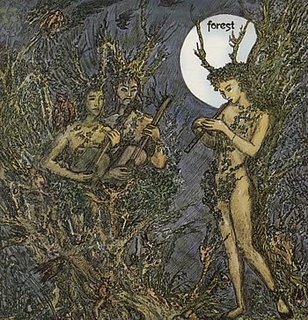
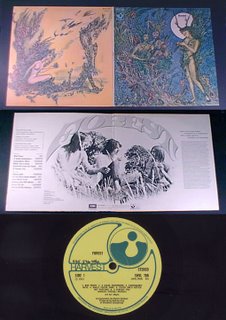
forest (rare earth XIV)

forest - forest (uk, 1969)

Issued by Harvest in 1969, this is one of the definite debut folk albums of all time. "As the 1960s progressed, almost every musical genre was affected by the psychedelic boom -- and folk was no exception. Forest, whose two Harvest albums have long elated listeners and eluded collectors, featured prominently among them, and have become synonymous with so-called 'acid folk', inspiring -- alongside Vashti Bunyan, COB and a handful of others -- the current wave of successful underground folk acts. This, their debut album was recorded at Abbey Road early in 1969 and featured completely original material, with their strangely-sculptured melodies and partially improvised accompaniment. Originally called The Foresters Of Walesby the band abbreviated their name to Forest and were fortunate enough to meet John Peel at a local gig and he encouraged them to play in London. After a triumphant gig in Notting Hill's All Saints Hall at Christmastime 1968, Forest were offered a management deal with Blackhill Enterprises, home to amongst others, Pink Floyd and Roy Harper. It wasn't long before offers of record contracts came their way and the band eventually signed to EMI's nascent Harvest label.

Cuando uno se adentra en frondosos y escondidos parajes sueña con perderse, en un día suerte, en un bosque y escuhar entre los árboles: 'Lovemaker's Ways', 'Bad Penny', 'Sylvie (We'd Better Not Pretend)', 'Glade Somewhere' o 'Fanding Lights', rústicas, sombrías y medievales melodías que un trío de trovadores multinstrumentistas recogió para Harvest y que Radioactive ha recuperado en limitados lp's como ya ha hecho con otras gemas, también BGO ha unido su debut con su otro album 'Full Circle' de 1970. Las mágicas noches en el bosque se esculpen en psych-folk, acid-folk, mandolinas, clavicordios, flautas, armonios, percusiones, armónicas, 12 cuerdas y pianos, así se adivina la sombra de The Incredible String Band, Dr. Strangely Strange y Trees, se cuela el surrealismo, lo arcano y lo pagano, los trovadores del folk lisérgico... pero los bellos y delicados arreglos con ese tono silvestre a lo Clive's Original Band iluminan la oscuridad de un sueño del que no quieres despertar.

Martin Welham: vocals, 12 string guitar, harmonium, piano, pipes, percussion, organ
Derek Allenby: mandolin, harmonica, pipes, harmonium, percussion, vocals
Hadrian Welham: guitar, mandolin, vocals, pipes, cello, electric harpsichord, harmonium, percussion, mandolin, organ

Sep 30, 2006

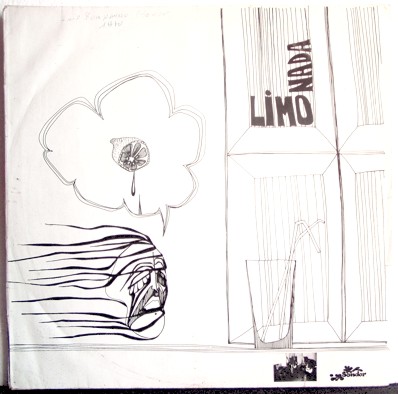
limonada (rare earth XIII)

Limonada (Uruguay, 1970)

Although they sprung ready-made from the ashes of legendary candombe/beat group El Kinto, one of the best-kept secrets from Uruguay's musical mythology is nevertheless the group of musicians who recorded one album as Limonada. So what happened? The story starts with the end of El Kinto, when band leader and iconoclastic maniac Eduardo Mateo decided to embark on a solo career, and the other members of El Kinto said 'let's do something together.' And so it was that in the middle of 1970, Limonada recorded their one and only album, LimoNada, originally released by Sondor. It is a strange record, with backwards tape splices, abrupt song changes, yet at the same time it is absolutely accessible and very groovy, in a Tropicalia sort of way, which might explain why it was an immediate success. In truth, it's a profound mystery why the Limonada LP seems to have vanished from the consciousness of even the most devoted fans of obscure music. Until now, of course. This carefully researched reissue contains the entire LimoNada LP (its reissue debut), supplemented by an extended live bonus track. The sixteen page booklet includes historical background on the Uruguayan scene, details of the band's past, plenty of photos, as well as a brief overview of the legendary Sondor label.

¡Limándose, exprimiéndose, enjuagándose, limotodo o limonada!... reeditado por el sello canadiense Lion Productions el año pasado y originalmente publicado por Sondor, Uruguay, un país más modesto en lo musical al lado de Chile o Perú, regaló en época de grabaciones perdidas el trago más especial de sudamérica. Walter Cambón - guitarra, voz-, José Luis Sosa -batería-, Dardo Martínez -guitarra, piano, teclados-, Ricardo Lanza -bajo, voz-, Tito Caballero -flauta- llevan los zapatos rotos en su largo caminar y portan un candombe-beat simple en apariencia y que discurre en parajes folcloricos, aderazados por percusiones, bossa-nova, psicodelia, vientos, cambios, melodías y voces soñadoras y trazos casi invisibles que acentúan la sensación de un disco conceptual en el que sólo hay canciones, 'Pasteles Verdes', 'Viejo Tambor', 'Dejenme Dormir' y la evocadora 'Pies Descalzos' preciosa en disco y aún más en el festival de Tacuarembó, transformada en una explosión de candombe-jazz.

Sep 4, 2006

pekka streng (rare earth XII)

pekka streng - magneettimiehen kuolema (1970)

Olen ollut kauan poissa teidän luotanne, tästä ajasta, tästä kaupungista. Olen ilmaa kevyempi, hyvin vaikeasti havaittavissa. En voi edes puhua teille. Olen kuollut. — Tai paremminkin: olin kuollut, mutta yllätyksekseni löysin itseni eräänä iltapäivänä selailemassa sanomalehteä puiston penkiltä, täysin lihallisena ja hyvässä voinnissa. Se oli välähdyksenomainen oivallus, joka haihtui samantien. Siitä hetkestä lähtien olen tiennyt olevani "elossa". Kun lähdin olin vielä lapsi. Muistan, miten hento ruumis peitettiin vanhalla ikkunaverholla. Sen jälkeen olen kieltämättä varttunut aika lailla. Minusta oli tullut menestyvä ja toimelias mies. Kaikki olisi ollut hyvin ja minä olisin voinut rauhassa elää elämääni yhtäaikaa ja erikseen sekä karkeammassa että hienommassa olomuodossani, mutta huomasin, että maallinen minäni oli niin syvässä, aikakaudelleen ominaisessa horteessa, etten voinut jättää häntä. — Päätin laskeutua takaisin aineeseen. Ensin ajatus tuntui vastenmieliseltä vaikka kysymyksessä olikin uhraus minun itseni hyväksi, mutta mitä enemmän sitä ajattelin, sitä enemmän huomasin maa-elämässä houkutteleviakin piirteitä. Vanhoja muistoja tulvi tajuntaani. Keksimäni miellyttävät asiat alkoivat kasvaa ja kun en pyrkinytkään hillitsemään mielikuvitustani, tuli aineeseenlaskeumisesta lopulta pakonomainen tarve. Leijun tulevan kotikaupunkini yläpuolella. Sen merkitys minulle kasvaa hetki hetkeltä. Samoin käy minulle ymmärrettävämmäksi koko ajan. Jokainen sanoiksi selkeyttämäni ajatus tuo minua lähemmäksi teitä. — Tämä on ahdistavaa. Muistini.

Pekka Streng era un filandés que falleció de cáncer con sólo 26 años, al que quizá un día se descubra y sea obligado referenciar, antes de morir tuvo tiempo y talento para publicar dos discos y un puñado de singles, cuenta que se ha visto aumentada con los años en forma de reediciones y material anterior a su primer disco 'Magneettimiehen Kuolema', algo así como La Muerte del Hombre Imán que gabró a sus 21 años con una recomendable banda de jazz-rock de la región, Tasavallan Presidentti. Experimentación acústica, psych-folk, flauta, percusiones, saxo y Pekka a la guitarra que en compañía no abandona el aire introspectivo, místico y preciosista; el sol se cuela entre la hojas de 'Olen erilainen', 'Pitkä Kieli', 'Olen Eläin' .... que se codea con nombres y obras maestras de 1970 como Damon y Simon Finn -y de cualquier época-, de verdad.

Magneettimiehen kuolema (Love LRLP 28, 1970)
Kesämaa (Love LRLP 67 / LRC 67, 1972)

Ellipsi (es. Maikki Sirjamo): Pieni juhlija. 7" single (Love LRS 1036, 1969).
Kappale mukana myös eri esittäjiä -kokoelmalla Pieni juhlija (Love LXLP 510, 1971).
Tasavallan Presidentti: Sisältäni portin löysin. 7" single (Love LRS 2001, 1972)

Pitkä kieli
Nousin pitkän kielen päälle,

se on minun kieli.
Annan sen minua viedä
paratiisiin päin.

Mut hei, tulkaa mukaan
pitkän kielen päälle,
se luikertelee jalkani alla
paratiisiin päin!

Olin siitä unia nähnyt
ennen kuin sen löysin.

Ja paljon minulle luvattiin,
jos sille astuisin.

Hei sisko, paljon minulle luvattiin,
aaa, jos sille astuisin!

Tyt-tyy-dy...


Nyt muuttuu kaupunki lämpimäksi,
seireenin laulun kuulen.

Käy ambran tuoksu sieraimiini,
aistit huumaantuu.
Mut hei, tulkaa mukaan
pitkän kielen päälle,
se luikertelee jalkani alla
paratiisiin päin!

Olen magneettimies, ahaa!
Magneettimies!

Juoksen puulta toisen luo,
kaikin voimin ravistan.
Juoksen puulta toisen luo,
kaikin voimin ravistan.Haluan hedelmän arvaamattoman.
Haluan maistaa puuta jumalan.(Juoksen puulta toisen luo...)

Aug 13, 2006

affinity (rare earth XI)

Affinity - Affinity (1970)

Tenía parado este post desde al año pasado y el domingo es buen día para un paseo al atardecer por el parque del jazz-rock de Affinity y sus recovecos de folk-rock, british blues y la estela del canterbury más evocador, Delivery y Carol Grimes, Caravan y David Sinclair. Intrincados cambios, melodías, ocasionales arreglos de viento y percusiones que se unen al excitante encuentro de cuerdas con el excelente Hammond de Lyton Naiiff, trazando solos para la emocionante y definitiva voz de Linda Hoyle, mientras pisas la hojas húmedas del suelo, 'I Am and So You Are' o 'Night Flight' son como 'Golf Girl' no puedes resistirte, 'Coconute Grove', 'Three Sisters'', un cover de Dylan... y dos bonus en la edición de akarma (2000) en vinilo naranja de 180 gr. con portada abierta que hace aún más apetecible el abrirse paso por uno más de esos discos que en aquellos finales de década trataba de escapar.


Lynda Hoyle- vocals
Lynton Naiff-piano/electric piano/harpsichord and vibraphone
Mike Jopp-electric/acoustic and 12-string guitars
Mo Foster-electric and double bass
Grant Serpell-drums and percurssion


Pd.: Además se ha recuperado material anterior y posterior con distintas formaciones a la de su único disco oficial, al año siguiente Linda publicaría un apreciable debut en solitario, 'Pieces of Me'.

Jul 13, 2006

clive's original band (rare earth X)

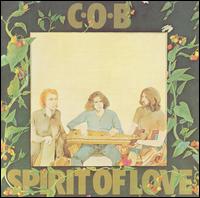
Clive's Original Band - Spirit Of Love (1971)

Clive Palmer is one of those people whose name is know and respected by many, but very few people really know Clive because he seems to treat each project, whether it be a band or the making of a pair of boots or the Japanase method of making, as a challenge and once its creation is over he moves to the next thing. (That's how it appears to have been with the Incredible String Band, originally known as Clive's Original Band. Once their first album was finished Clive took his advance from the record company and disappeared to India. On his return he played with Wizz Jones and founded the now defunct Famous Jug Band). Clive is probably best known as a banjo player and had to borrow one for one number on this album.

Mick Bennett and I had a Jug Band in Cornwall a few years ago and it was whilst we were playing together taht we first met 'Little John' Bidwell who often played in the same club. Because of the close knit musical community all three played together in various permutations with ohter muscians. Two of the most notable band to emerge the Stockroom Five and the Templa Creatures. With the talents of Mick and John it seems that Clive has found a solution to the question of challenge. Whereas in the past it was largely left to Clive to decide direction, in this band each member sets the others off and provides new stimulus. In John, Clive has a found musician of similar tastes and great ability and Mick a lyricist, poet and vocalist and together they keep enthusiasm bubbling all the time. All the guys have known hard times, two winters spetn living on potatoes, flour and water in an old caravan miles from the nearest road, but all the time making music. I hope this album has captured some of that musica and atmosphere mady by John, Mick and Clive. They're called Clive's Original Band because taht's what they are...

Notas de Ralph McTeil en la modesta y bonita reedición -2002- del disco por Lady Eleanore de Clive Palmer, Mick Bennet y John Bidwell que incluye las letras. Ocultos entre los árboles del british-folk pagano, Shirley Collins a capella, armonías vocales, coros femeninos, pinceladas a Incredible String Band... y envueltos en una maleza de guitarras, banjos, chelos, bongos, dulcitar, aroma barroco y misticismo hindú, desfilan 'Serpent's Kiss', 'Wade in the Water', 'Spirit of Love', 'Evening Air' o 'Banjo Land', soñadoras sinfonías de tres trovadores del bosque.